
Yes, a manual testing career is still a good choice in 2026, as long as you treat it as the starting point and not the whole plan. Fresher hiring in India still leans on manual testing, but the pay data and the job titles point the same way: add API testing, SQL or some automation early. In this guide we share listing counts and salary figures we checked ourselves, what the large testing surveys say about AI, and a 30-minute exercise that shows what the work actually feels like. You need a laptop with Chrome. Nothing else.
Last tested on: the practice exercise was run in Google Chrome 154 on Windows, October 2026. Job listings and salary pages were checked on 7 October 2026. Tool versions mentioned: Selenium 4.50.0 and Playwright 1.63.
In short
- Manual testing is a sensible way into QA in 2026. It is a weak place to stay for years without adding anything.
- On Naukri on 7 October 2026, a search for “manual testing” with experience set to 0 years showed 7,094 listings. “Automation testing” with the same filter showed 1,944.
- Self-reported pay on AmbitionBox is clearly higher for automation test engineers, so plan your second skill in the first year.
- What scripts and AI tools do badly is judgement: choosing what to check and noticing what looks wrong. That part can be learned, and the exercise below is a start.
What this guide covers
Is manual testing a good career in 2026? We counted the jobs
Most answers to this question come from someone selling something. A training institute says yes, because it has a manual testing batch starting Monday. A tool company says manual work is ending, because it sells automation. So we stopped reading opinions and went to count.
On 7 October 2026 we searched Naukri.com for a few testing keywords, with no location filter. These are the numbers the result pages showed.
| Search on Naukri | Listings shown |
|---|---|
| manual testing | 111,012 |
| automation testing | 47,649 |
| manual testing, experience set to 0 years | 7,094 |
| automation testing, experience set to 0 years | 1,944 |
| manual tester | 10,529 |
| selenium | 10,319 |
| playwright | 3,211 |
Read this table with care. Naukri matches keywords loosely, so the same job can appear under several searches, and a result for “manual testing” may be a role that wants automation as well. The first count moved by a few listings while we were still writing. It is a rough signal. It is not a census.
Still, one thing is hard to argue with. With the experience filter at 0 years, “manual testing” showed more than three times the listings of “automation testing”. For a fresher in India, the door into QA is still mostly a manual testing door.
Then we read the first 20 results for “manual testing”. Six of those 20 job titles asked for manual plus automation or API testing in the title itself. Others named a domain: payments, medical devices, embedded systems. So a good share of “manual” jobs are really manual plus something.
Manual testing salary in India: what testers report
We are not going to promise you a package. Nobody honest can. What we can show is what testers themselves have entered on AmbitionBox.
For Manual Test Engineer, the typical range shown was ₹4.3 to ₹4.8 lakh a year for 1 to 5 years of experience, based on about 12,500 salaries. For Automation Test Engineer it was ₹7.3 to ₹8.1 lakh a year for 2 to 6 years, based on about 45,400 salaries. The same pages showed average pay rising 8% in two years for the manual title and 18% for the automation title.
Two cautions. The numbers are self-reported, and the experience bands differ, so this is not a like-for-like comparison. City, company and your own interview matter more than any average. The direction is the useful part.
There is a twist that the “just learn Selenium” advice misses. PractiTest’s State of Testing 2026 report, a global survey, says senior testers who rely only on technical execution skills, with automation scripting given as the example, earn 13.8% less, while seniors who build leadership and strategy skills earn 10.6% more. So coding alone is not the finish line either. Thinking is.
Will AI replace manual testers?
Short answer: it is replacing some tasks, not the role. First the survey numbers, then our opinion.
The World Quality Report 2025 says 89% of the organisations it surveyed are piloting or deploying generative AI in quality engineering, but only 15% have rolled it out across the enterprise. PractiTest found 70% using AI for test case creation and only 19.9% using it for risk identification.
Developers are in a similar spot. In the Stack Overflow 2025 Developer Survey, 84% of respondents use or plan to use AI tools, yet more of them distrust the accuracy of the output (46%) than trust it (33%). The top frustration, named by 66%, was AI answers that are nearly correct but not fully.
Now our opinion. AI is taking over the typing part of testing: first drafts of test cases, boilerplate scripts, test data. It is much weaker at the judging part, which is deciding what matters to a user in Patna on a slow network, and noticing that a screen technically works but feels wrong. When more code gets written faster by tools that even developers do not fully trust, somebody has to check it. That somebody is a tester. Nobody knows what the next five years look like, and anyone who claims to is guessing.
If this makes you nervous, you are in the majority. In the same PractiTest report, 65.6% of testers said they were very concerned about the future of the profession.
Where manual testing wins and where automation wins
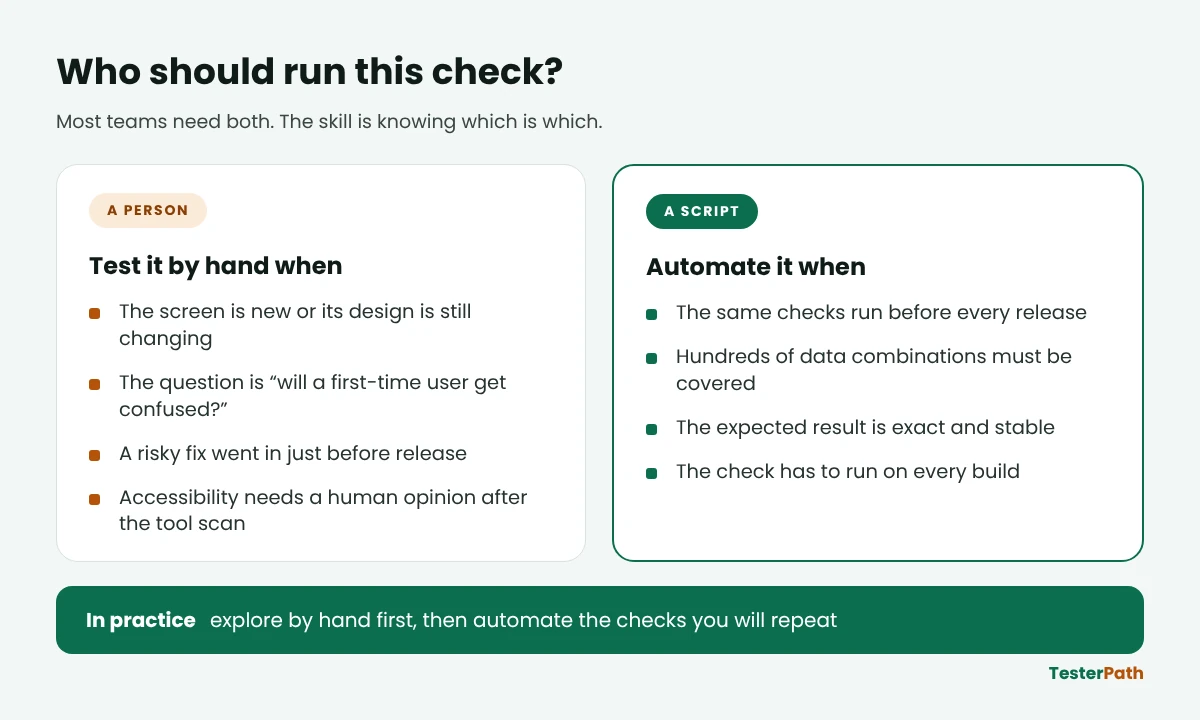
A common mistake is to treat this as a fight. In most teams the real question is much smaller: for this particular check, should a person do it or a script?
| Situation | Better choice | Why |
|---|---|---|
| A new screen whose design is still changing | Person | Selenium’s own docs warn that automation may need rewriting when the UI is about to change a lot |
| The same regression checks before every release | Script | Repeating identical steps by hand is slow, and attention drops by the fortieth run |
| "Is this payment screen confusing for a first-time user?" | Person | A script checks what it was told to check. It has no opinion about confusion |
| Accessibility of a form | Tool first, then a person | W3C says tools cannot check every accessibility aspect and human judgement is required |
| 500 combinations of pincode and delivery slot | Script | Feeding many rows of data through one check is what scripts do well |
| Tight deadline and no automation exists yet | Person | Selenium’s docs call manual testing the best solution in exactly this case |
| A risky fix went in an hour before release | Person | A short exploratory session finds surprises sooner than writing a new script |
Manual testing has real limits. It is slow. It does not scale to thousands of checks. Two testers can run the same case and report different results, and afterwards it is hard to prove what was covered. That is why teams automate the repeatable part, and why a tester who can only execute steps is easy to replace.
Try it yourself: a 30-minute manual testing exercise
Before you commit to a manual testing career or pay for a course, spend half an hour on this. It tells you more about whether you will enjoy the work than any career video.
- Open the-internet.herokuapp.com/inputs in Chrome. It is a free practice page with a single Number field.
- Imagine that field is the amount box on a UPI payment screen. Before you touch it, write down ten things you want to try.
- Try each one. For every attempt, note what you would expect a real payment app to do, and what the page actually did.
- To see the value the field is really holding, press F12, open the Console tab and run this one line of JavaScript.
document.querySelector('input').valueHere is our own run. The Expected column is what we would want from a real amount field. The practice page has no business rules, so a mismatch here is not a bug in that site. It is a question you would raise in a real project.
| ID | Scenario | Test data / steps | Expected in a real amount field | What happened on the practice page | Type |
|---|---|---|---|---|---|
| TC01 | Valid whole number | Type 500 | Accepted | Accepted, value 500 | Positive |
| TC02 | Letters | Type abc | Not accepted | Nothing appeared in the field | Negative |
| TC03 | The letter e alone | Type e | Not accepted | e stayed visible, but the value read back empty | Negative |
| TC04 | Exponent notation | Type 1e3 | Not accepted | Accepted, read as 1000 | Edge |
| TC05 | Negative amount | Type -50 | Rejected with a message | Accepted, value -50 | Negative |
| TC06 | Three decimal places | Type 10.555 | Limited to two decimals | Shown as typed, no message | Boundary |
| TC07 | Leading zeros | Type 000123 | Shown as 123 | Shown as 000123, read as 123 | Edge |
| TC08 | Plus sign | Type +5 | Sign ignored or rejected | +5 stayed visible, value read back as 5 | Edge |
| TC09 | Space in the middle | Type 12 34 | Space ignored | Space ignored, value 1234 | Edge |
| TC10 | Two decimal points | Type 1.2.3 | Second point ignored | Second point ignored, value 1.23 | Negative |
| TC11 | Down arrow on an empty field | Press the down arrow once | Stays empty or stops at the minimum | Value became -1 | Boundary |
| TC12 | Very large number | Type 9 twenty-three times | Rejected above the allowed limit | Accepted, no limit | Boundary |
| TC13 | Up arrow on that large number | After TC12, press the up arrow once | Goes up by 1 or stays the same | Field changed to 9.99999999999999999e+22 | Edge |
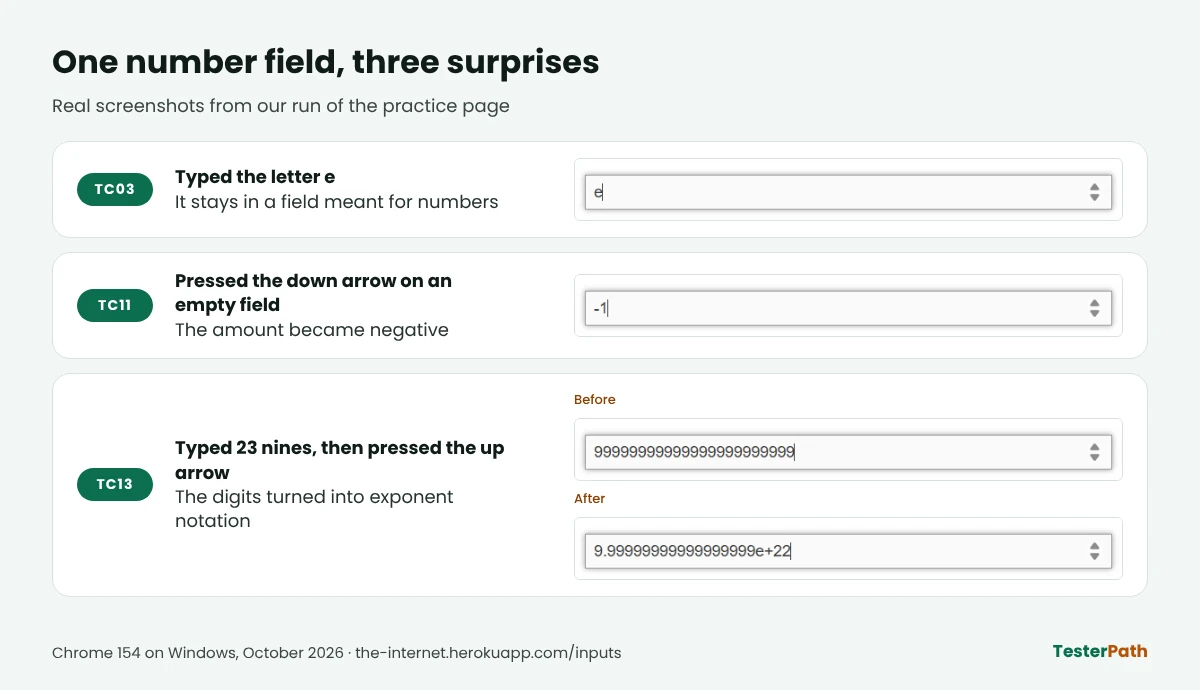
Look at TC03, TC05 and TC13. A written test case for an amount field usually says “enter a valid amount, verify success”. Nobody writes “press the up arrow on a 23-digit number”. You find that one by being curious, and curiosity is the part of this job a script does not have.
Why does e get through? Chrome lets it in because number fields accept exponent notation, which is also why 1e3 was read as 1000 in TC04. MDN’s page on the number input warns that some browsers allow invalid characters, and that form validation in the browser is no substitute for checks on the server. That matters for your career. A tester who only sees the screen stops at TC05. A tester who can send the same -50 straight to the API learns whether the server refuses it too. If you have never sent an API request, our Playwright vs Postman for API testing guide walks through four small checks.
TC13 has a simple cause. JavaScript cannot hold whole numbers that large exactly. Type Number.MAX_SAFE_INTEGER in the same Console and you get 9007199254740991, its largest safe integer. Any numeric field without an upper limit can behave like this.
If you enjoyed that half hour, and your own list had ideas ours did not, testing will probably suit you. If it bored you, better to find out today than after a six-month course.
Which skills to add after manual testing
People often ask which testing tool is in demand in 2026. On Naukri that day, “selenium” showed 10,319 listings and “playwright” showed 3,211. Selenium (4.50.0 at the time of writing) still appears in far more Indian listings, and Playwright (1.63) is clearly present too. Either is fine. Pick the one the teams you are applying to already use.
The order matters more than the tool. This is the order we would suggest to a junior teammate. It is opinion, not a rule.
- Test design: equivalence partitioning and boundary value analysis from the ISTQB Foundation syllabus. TC06, TC11 and TC12 above are boundary thinking.
- API testing with Postman, because most screens sit on top of APIs.
- SQL, enough to check that the screen matches what the database stored.
- One automation tool with one language, for the regression checks you are tired of repeating.
- Your domain: payments, insurance, healthcare. It is slow to learn and hard to replace.
In Katalon’s State of Software Quality Report 2025, 68% of testers agreed that automation scripting and programming skills remain essential. The ISTQB Foundation syllabus lists the general skills a tester needs: testing knowledge, thoroughness and curiosity, communication, analytical thinking, technical knowledge and domain knowledge. None of those is the name of a tool.
Common mistakes when starting a manual testing career
Choosing manual testing because “there is no coding”. That gets you through the door and then becomes the reason you are stuck. Decide in your first six months what your second skill will be.
Paying for a course because of a “100% placement” line. No institute controls who gets hired. Ask for the syllabus and check whether it reaches API testing and SQL or stops at definitions.
Running test cases without understanding the feature. Suppose the rule says a refund must go back to the same UPI ID it was paid from. If you do not know that rule, you will pass a test that should fail. Read the requirement before you execute anything.
Writing bug reports nobody can act on. “Login not working” costs a developer their morning. Give the steps, the test data, the expected result, the actual result and a screenshot or screen recording.
Jumping to Selenium before learning test design. Automating a weak test gives you a weak test that runs faster. Learn to pick good cases by hand first.
What the official docs say
The ISTQB Certified Tester Foundation Level syllabus (v4.0.1) lists seven testing principles, and three of them explain this whole debate. Exhaustive testing is impossible, so somebody has to choose what to test. Tests wear out: repeat the same ones and they stop finding new defects, which is the argument for exploring. Then there is the absence-of-defects fallacy: a product can pass every specified check and still not be what its users need.
The same syllabus describes exploratory testing as designing, running and evaluating tests at the same time while you learn about the product, often in time-boxed sessions guided by a test charter. The ISTQB Glossary (V4.8.1) says much the same: tests are designed and executed on the go, from what the tester knows and what earlier tests showed.
Selenium’s documentation, from a project whose whole purpose is browser automation, says plainly that automating a test is not always an advantage. It names two cases: a user interface that is about to change considerably, and a tight deadline with no automation in place.
W3C’s Web Accessibility Initiative states that evaluation tools cannot check all accessibility aspects automatically, and that human judgement is required.
The survey reports quoted earlier are a different kind of source. They record what respondents said, mostly outside India. Useful, but not rules.
Interview questions on a manual testing career
Why did you choose testing and not development?
Do not say coding is difficult. Say what you enjoy: working out how something breaks, and seeing a screen the way a user would. Then give one thing you tested, even the practice exercise above.
Can every test be automated?
No. Checks that repeat and have a clear expected result are good candidates. Usability, exploratory testing and a feature that is still changing need a person. Scripts also cost time to maintain.
What is exploratory testing?
Testing where you design and run tests at the same time, using what you learn from each result to decide the next step. It is usually time-boxed and guided by a short charter, so it is not random clicking.
Write test cases for an amount field.
Start with one valid value. Then cover the boundaries: minimum, maximum and just outside each. Then wrong types such as letters, negatives and extra decimals. Finish with odd inputs like e, spaces and pasted text.
FAQ
Is there any future in manual testing?
Yes, though not for roles that only execute written steps. Tool documentation and surveys agree that exploratory, usability and accessibility work needs human judgement. On Naukri on 7 October 2026, fresher listings for manual testing outnumbered those for automation testing. The future belongs to testers who keep the manual thinking and add API, SQL or automation skills.
Will AI replace manual testers?
Not the whole role, going by current data. The World Quality Report 2025 found 89% of organisations piloting or deploying generative AI in quality engineering, but only 15% using it enterprise-wide. AI drafts test cases quickly. Deciding what is risky, and judging whether a screen makes sense to a user, still needs a person.
Which testing tool is in demand in 2026?
In our Naukri check on 7 October 2026, Selenium appeared in 10,319 listings and Playwright in 3,211. API testing and SQL also appear in many tester job descriptions. Pick one automation tool and learn it properly. Interviewers care more about how you design tests than about how many tools you list.
Is testing a good career in 2026?
Software testing is a workable career in 2026 for people who enjoy finding problems and explaining them clearly. Listings exist across manual, API and automation roles, but pay and growth differ a lot by skill and company. Nobody can guarantee a job or a package, so judge by the skills you can actually demonstrate.
Is manual testing a good career in India for freshers?
It is still a reachable way into QA. With the experience filter at 0 years, Naukri showed 7,094 manual testing listings against 1,944 for automation testing on 7 October 2026. Treat the first job as paid training, and start learning API testing and SQL within the first year.
What to do this week
Do the 30-minute exercise today and keep your notes. They are your first test cases, and a better interview answer than any memorised definition. Then send your first API request. Our comparison of Playwright and Postman for API checks is a gentle place to start, and the API Testing section will collect more as we publish them. For more on pay, interviews and growing a manual testing career into automation, keep an eye on the QA Career guides.
Sources
- ISTQB – Certified Tester Foundation Level Syllabus (v4.0.1, 2024)
- ISTQB – Glossary entry: exploratory testing (Glossary V4.8.1)
- Selenium – Overview of Test Automation (documentation, 2026)
- Selenium – Downloads (stable 4.50.0, September 2026)
- Playwright – Release notes (version 1.63)
- W3C Web Accessibility Initiative – Selecting Web Accessibility Evaluation Tools (2024)
- MDN Web Docs – <input type=”number”> (2026)
- Capgemini, Sogeti and OpenText – World Quality Report 2025, press release (17th edition, November 2025)
- PractiTest – The 2026 State of Testing Report (13th edition)
- Stack Overflow – 2025 Developer Survey: AI (2025)
- Katalon – State of Software Quality Report 2025 (2025)
- Naukri.com – Manual testing job listings (result counts noted on 7 October 2026)
- AmbitionBox – Manual Test Engineer salaries in India and Automation Test Engineer salaries in India (updated October 2026)
Tools and features change often. Check the official documentation for the version you are using.