A good software testing resume for fresher jobs fits on one page, uses a plain single-column layout, and is built around proof: test cases, bug reports and small practice projects that an interviewer can actually open. Put a two-line summary first, then grouped skills, then one or two projects, then education. Below you will find a free sample you can download, what to write in each section, and how to build the project work in a weekend or two. All you need is a word processor, a GitHub account and some patience.
Last checked: October 2026. Parsing advice checked against Greenhouse Support, certification details against ISTQB CTFL v4.0 (syllabus 4.0.1). The text-extraction test below was run with pdftotext 24.02.0.
In short
- Keep it to one page and one column. Fancy two-column templates can confuse the software that reads your resume first.
- Recruiters cannot test your “attention to detail”. They can open a GitHub link with 40 test cases and five clear bug reports.
- Write project bullets as action plus evidence: what you tested, how many, and what came out of it. Use only real numbers.
- Every line on the page is a possible interview question. If you cannot explain it for two minutes, remove it.
What this guide covers
What recruiters look for in a fresher tester’s resume
Here is the problem every fresher faces. You have no job history, so the resume fills up with claims: hard-working, quick learner, good communication, strong analytical skills. Everybody writes the same four phrases, and nobody can check any of them.
Testers have an advantage here. Testing work leaves documents behind: a test case sheet, a bug report with a screenshot, a Postman collection. These are the same things you will produce on the job, so a recruiter who opens them sees a sample of your future work instead of an adjective.
That changes what each line on the page should do. Compare these:
| Line that gets skimmed | Line that gets a call |
|---|---|
| Good knowledge of manual testing | Wrote [number] test cases for login, cart and checkout on a public practice store; link on GitHub |
| Familiar with Jira and bug tracking | Reported [number] bugs with steps, expected and actual result, severity and screenshots |
| Strong analytical skills | Used boundary value analysis for the quantity field and found [what you found] |
| Knowledge of API testing | Checked create, read, update and delete requests in Postman; collection and README on GitHub |
The right format: one page, one column, simple file
Many companies put your resume through an applicant tracking system (ATS) before a person reads it. It pulls your name, contact details and skills into fields. If it reads your file badly, a recruiter searching for “Postman” may never see you.
Greenhouse, one of the common ATS products, publishes a help page on why resumes fail to parse. The list is useful because it is so specific: files over 2.5 MB, photos and graphics, text saved as an image, tables, headers and footers, text boxes, multi-column layouts, contact details placed inside a header or footer, and section names that are not clear. Other systems behave differently, so treat this as a warning list, not a law for every company.
| Do this | Avoid this |
|---|---|
| One column, top to bottom | Two-column templates with a coloured sidebar |
| Normal section names: Summary, Skills, Projects, Education | Creative names like “My Toolbox” or “Journey so far” |
| Name and contact details in the body of the page | Contact details inside the header, footer or a text box |
| Skills written as words | Skill bars, stars or percentages |
| A PDF or .docx exported from Word or Google Docs | A scanned image or a photo of a printed resume |
| One page, under 1 MB | Three pages of course modules and hobbies |
The honest trade-off: a plain resume looks boring next to a colourful Canva design. That is fine. Hiring in testing is not a design contest, and the plain one is the one that gets read correctly.
PDF or Word? Use PDF unless the job portal asks for .docx. A PDF keeps your layout fixed on every device. Our template comes in both formats, so you can edit the Word file and export the PDF.
What to write in each section
Header and resume headline
Your name in large text, then one line that says what job you want. “Software Test Engineer (Fresher) | Manual Testing and API Testing” works better than “Seeking a challenging role”, because a recruiter can tell in two seconds which opening you fit. Under that: city, phone, a professional email, LinkedIn and GitHub.
You do not need your date of birth, father’s name, marital status or a photo. Many older Indian resume formats include them, but they tell the recruiter nothing about your testing ability, and photos are on the Greenhouse list of things that can disturb parsing.
Summary (two or three lines)
Skip the objective that starts with “To work in a reputed organisation”. Write what you are, what you have done and where the proof is. For example: “B.Tech (Computer Science) graduate, 2026, looking for a fresher software testing role. I have tested two public practice applications from start to finish and shared my test cases, bug reports and Postman collection on GitHub.”
Skills, grouped and honest
Group skills under a few short labels so the page is easy to scan: testing techniques, test documents, tools, technical basics. Then do the hard part. Remove anything you could not demonstrate in an interview tomorrow.
If you attended a two-hour Selenium demo, Selenium does not belong in your main skills. Put it under “Learning now” or leave it out. Expect at least one question on every tool you list. A single “I only saw it in a class” answer can make the panel doubt the rest of the list too.
Projects: the section that decides the call
For a fresher, projects replace work experience. One or two strong projects beat six weak ones. A strong project has a name, the application you tested, the month, a link, and three or four bullets that say what you did.
You do not need a company project. Public practice applications exist for exactly this purpose. AutomationExercise says on its home page that QA engineers can use it for automation practice and API testing, and it has sign-up, login, product search and cart flows to test manually as well. For API work, Restful-Booker is a booking API created by Mark Winteringham for practising testing, and it openly says it contains bugs for you to find. Name the practice application honestly. Calling it a “client project” usually gets exposed by the very next question.
A college project or practice on our UPI payment test cases counts too, if you can show the documents.
Education and certifications
Degree, college, university, years and CGPA on one line. Class XII marks are optional. Some campus drives and application forms ask for them, so keep them if the companies you are targeting do.
For certification, the common one for testers is ISTQB Certified Tester Foundation Level (CTFL). ISTQB lists the current version as CTFL v4.0, with syllabus 4.0.1, and the CTFL page does not mention any entry requirement for the exam itself. Add it only after you pass. “Preparing for ISTQB” is allowed in an interview conversation, but on the page it reads like padding. A certificate can help you pass a filter. It does not replace project proof.
Free software testing resume sample for freshers
This is the template we made for this article. It follows everything above: one column, plain section names, contact details in the page body, no tables, no photos. Every [bracket] is a field for you to fill in with your own details. Nothing in it is a real person, and the numbers are left blank on purpose.
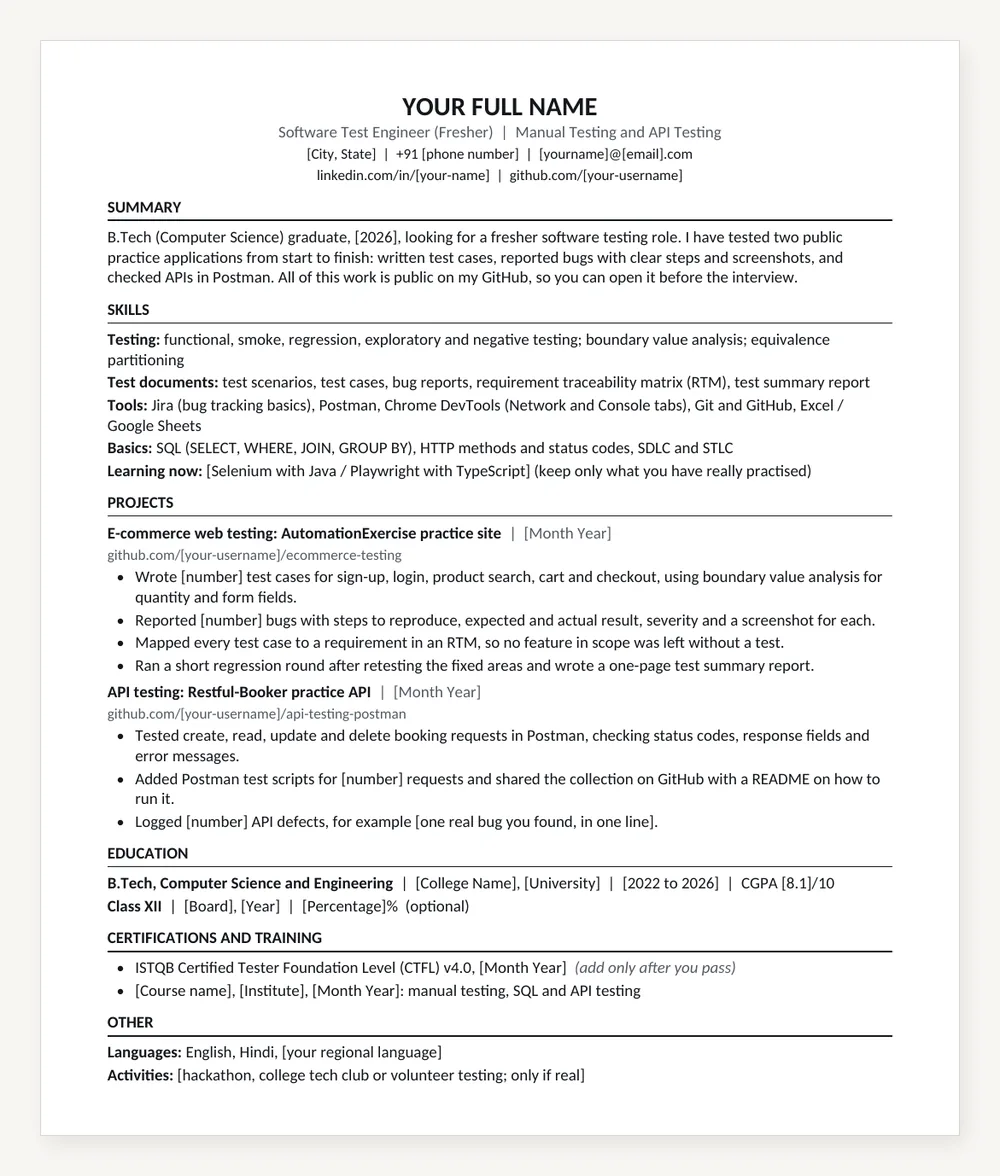
Replace the brackets, delete any line you cannot back up, and export a PDF named something like firstname-lastname-software-tester.pdf.
Hands-on: build the project proof, then check your resume
Most freshers write the resume first and look for projects later. Do it the other way round. These steps take a weekend or two, depending on your pace.
Step 1: test one practice application properly
- Pick one flow area, for example sign-up, login and cart on AutomationExercise.
- Write test cases in our free test case template. Cover positive, negative and boundary cases, not only the happy path.
- Run them and record pass or fail with the date.
- Log each real failure in the bug report template with steps, expected result, actual result, severity and a screenshot.
- Map test cases to features with the RTM template, and finish with a one-page test summary report.
Step 2: put it on GitHub where a recruiter can find it
Create a repository for the project and upload the sheets, the bug reports and a README that explains what you tested and what you found. GitHub also lets you add a profile README: make a public repository with exactly the same name as your username and put a README.md in it. That page shows at the top of your profile, so use it for three lines about yourself and links to your projects. You can pin up to six repositories or gists, so pin your testing projects first.
Step 3: turn the work into resume bullets
Google recruiters have described a simple pattern for resume bullets, reported by CNBC as “Accomplished X, as measured by Y, by doing Z”. For a fresher tester, X is what you tested, Y is a real count or result, and Z is the technique or tool. Here is how a weak bullet changes:
| Weak bullet | Better bullet |
|---|---|
| Did manual testing of an e-commerce website | Tested sign-up, login and cart on a practice store with [number] test cases, including boundary checks on quantity |
| Found bugs | Reported [number] bugs with steps and screenshots; [one-line example of your best bug] |
| Worked on Postman | Checked [number] booking API requests in Postman for status codes and response fields |
Only use numbers that are true. If an interviewer asks you to open the sheet and you wrote 120 test cases on the resume, there had better be 120 rows.
Step 4: check what a parser actually reads
You can’t see inside an ATS, but you can get a rough idea of the reading order with a plain-text extractor. We exported two test files from the same tool: our one-column template and a quick two-column layout with a skills sidebar on the left. Then we ran pdftotext (from Poppler, version 24.02.0) on both. Here is the first part of each output.
pdftotext one-column-resume.pdf - | head -5YOUR FULL NAME
Software Test Engineer (Fresher) | Manual Testing and API Testing
[City, State] | +91 [phone number] | [yourname]@[email].com
linkedin.com/in/[your-name] | github.com/[your-username]The one-column file comes out in the same order you read it: name, headline, contact details.
pdftotext two-column-resume.pdf - | head -11SKILLS
Manual testing
Postman
SQL
Jira
CONTACT
+91 [phone]
[email]
YOUR FULL NAME
Software Test Engineer (Fresher)In the two-column file, the whole left sidebar comes first. The phone number now sits under the skills, and the name appears only after the sidebar ends. A parser that expects the name near the top might fill the wrong field. This is a small test with one tool, not proof of how every ATS behaves, but it shows clearly why the Greenhouse list warns against multi-column layouts.
No command line? Open your PDF, select all, paste it into Notepad and read it from the top. If the order looks odd there, a machine will likely struggle too.
Manual testing resume for freshers vs automation
The structure stays the same. What changes is the evidence you put in the projects section.
| Part of the resume | Manual testing fresher | Automation testing fresher |
|---|---|---|
| Headline | Software Test Engineer (Fresher), Manual and API Testing | QA Automation Engineer (Fresher), [Selenium Java / Playwright TypeScript] |
| Main proof | Test cases, bug reports, RTM, test summary | A small, runnable test suite with a README and real run output |
| Skills to show | Test design techniques, SQL, Postman, DevTools | One language, one framework, Git, plus the manual basics |
| Common trap | Listing tools you have never opened | Copying a framework from YouTube that you cannot explain |
For automation roles, interviewers usually ask you to explain your own code line by line. Our Playwright interview questions guide shows the kind of questions that follow a framework on your resume.
Common mistakes on fresher testing resumes
- Copying the course brochure into Skills. Fifteen tools from the training syllabus tell the recruiter you attended a course, not that you can use them. Keep what you have practised.
- Rating your own skills. “Manual testing 90%” means nothing to the reader, and skill bars are graphics that may not parse. Show a project instead.
- Dressing up training as a job. A training-institute project labelled as “Client: XYZ Bank” is easy to expose with one question about the client. Call it a practice or training project.
- Using a two-column template from a design site. It looks great on screen. As the test above shows, the reading order can break once software pulls out the text.
- Sending one resume to every job. If a job post asks for API testing and SQL, those words should appear in your skills and projects, provided you really have them.
- Typos and a casual email address. A tester’s resume with spelling mistakes is an awkward first impression. Read it aloud once and ask a friend to check it.
What the official docs say
The formatting advice above follows the Greenhouse Support article on unsuccessful resume parses, which lists the layouts and file problems that stop a resume from being read correctly. The certification details come from the ISTQB CTFL v4.0 page and the CTFL syllabus 4.0.1, released in September 2024. The GitHub steps follow GitHub Docs on managing your profile README and pinning items to your profile. The bullet pattern is from Google recruiters, as reported by CNBC. Advice such as one page and no photo is our opinion, and some companies will differ.
Interview questions that come from your resume
In a fresher testing interview, the resume is the question paper. Expect these, and prepare answers from your own project.
“Walk me through one bug you reported.”
Pick your clearest bug. Give the steps, the expected and actual result, and why you chose that severity. Keep it under two minutes, with the report open on your phone.
“How did you decide which test cases to write?”
Name the technique and the field: boundary value analysis on the quantity field, so you tested 0, 1, the maximum and one above it. They want your reasoning, not a textbook definition.
“What is an RTM, and why did you make one?”
A requirement traceability matrix links each requirement to the test cases that cover it. In your project, it showed you which features had no tests yet. Saying what it did for you is better than reciting the full form.
“You wrote Postman tests. What did they check?”
Describe one request: the method, the endpoint, the expected status code and one response field you checked. If a test failed, say whether the API or your test was wrong.
Frequently asked questions
Should a software testing resume for a fresher be one page?
Yes, in almost every case. A fresher rarely has enough relevant material to fill two pages, and recruiters scan quickly. One page with a clear summary, grouped skills, one or two real projects and education is easier to read and easier to parse. Move extra detail to your GitHub README instead.
What should be the resume headline for a software testing fresher?
Use the job title you are applying for, plus your focus. For example: “Software Test Engineer (Fresher) | Manual Testing and API Testing”. It tells the recruiter which opening you fit within seconds. Avoid general lines like “Seeking a challenging position”, because they say nothing about testing.
Can I add training-institute or practice projects to my resume?
Yes, and for most freshers they are the most important section. Label them honestly as practice or training projects, name the application you tested, and link the test cases and bug reports. An interviewer will ask about them, so only add projects you actually worked on yourself.
Should I put ISTQB on my resume before I pass the exam?
It is better to add ISTQB CTFL only after you pass. You can mention in the interview that you are preparing for it. The certificate can help you clear some filters, but a project with real test cases and bug reports usually says more about your skills.
How do I write a software tester resume for a fresher with no experience?
Replace work experience with practice projects. Test one public practice application, write test cases, log real bugs and put the documents on GitHub. Then describe that work in three or four honest bullets with real counts. Add grouped skills, education and any certification you have actually passed.
Should I add a photo or date of birth to my resume?
Usually no. Older Indian formats often include a photo, date of birth and marital status, but none of these shows your testing ability. Photos can also cause parsing problems in some applicant tracking systems. Add them only if a specific company or form asks for them.
What to do this week
Download the template, but don’t fill it in yet. First test one practice application and put the documents on GitHub. Then the resume almost writes itself. If you are still deciding whether testing is the right path, read our guide to a manual testing career in 2026, then prepare with the interview prep questions. More career guides are in the QA Career & Interviews section.
Sources
- Greenhouse – Unsuccessful resume parse (Greenhouse Support, 2026)
- ISTQB – Certified Tester Foundation Level (CTFL) v4.0 (2026)
- ISTQB – Certified Tester Foundation Level Syllabus v4.0.1 (2024)
- GitHub – Managing your profile README (GitHub Docs, 2026)
- GitHub – Pinning items to your profile (GitHub Docs, 2026)
- CNBC – Google recruiters share the 3-part formula for stronger resumes (2018)
- AutomationExercise – Practice website for automation and API testing (2026)
- Restful-Booker – An API playground for practising testing (Mark Winteringham, 2026)
Tools and features change often. Check the official documentation for the version you are using.